Skip navigation

Capacitor PCB Pad Layout Recommendations

Solder pad design, solder application, and component placement are important elements of the soldering process. Excessive transfer of thermal or mechanical stresses to the MLC can result from oversized solder fillets. Nominal pad designs suitable for the solder reflow process are displayed in the interactive land pattern generator. These guidelines represent a starting point in Printed Circuit Board (PCB) design. For further information on the land pattern design, refer to the standard IPC-SM-782A “Surface Mount Design and Land Pattern Standard” published by the Institute for Interconnecting and Packaging Electronic Circuits (www.ipc.org).

Component Placement Considerations and Pitfalls


Solder pad design, solder application, and accuracy of component placement each must be considered when laying out circuits. This is especially true for RF and microwave circuits where incorrect or asymmetrical deployment of these parameters can lead to serious high frequency performance degradation. Designers beware. IPC-SM-782 is an excellent reference document for optimum soldering of components. However, blindly following this standard can lead to less than optimum high frequency performance and or high voltage issues. If you are not concerned with RF performance or high voltage requirements, Johanson recommends that designers follow this standard (IPC-SM-782). However, for those concerned with RF performance, we recommend a smaller land pattern (solder pad).

PCB pad layout drawing for a 0402 (CF, R07 legacy) surface mount capacitor showing component and pad dimensions in inches and millimeters
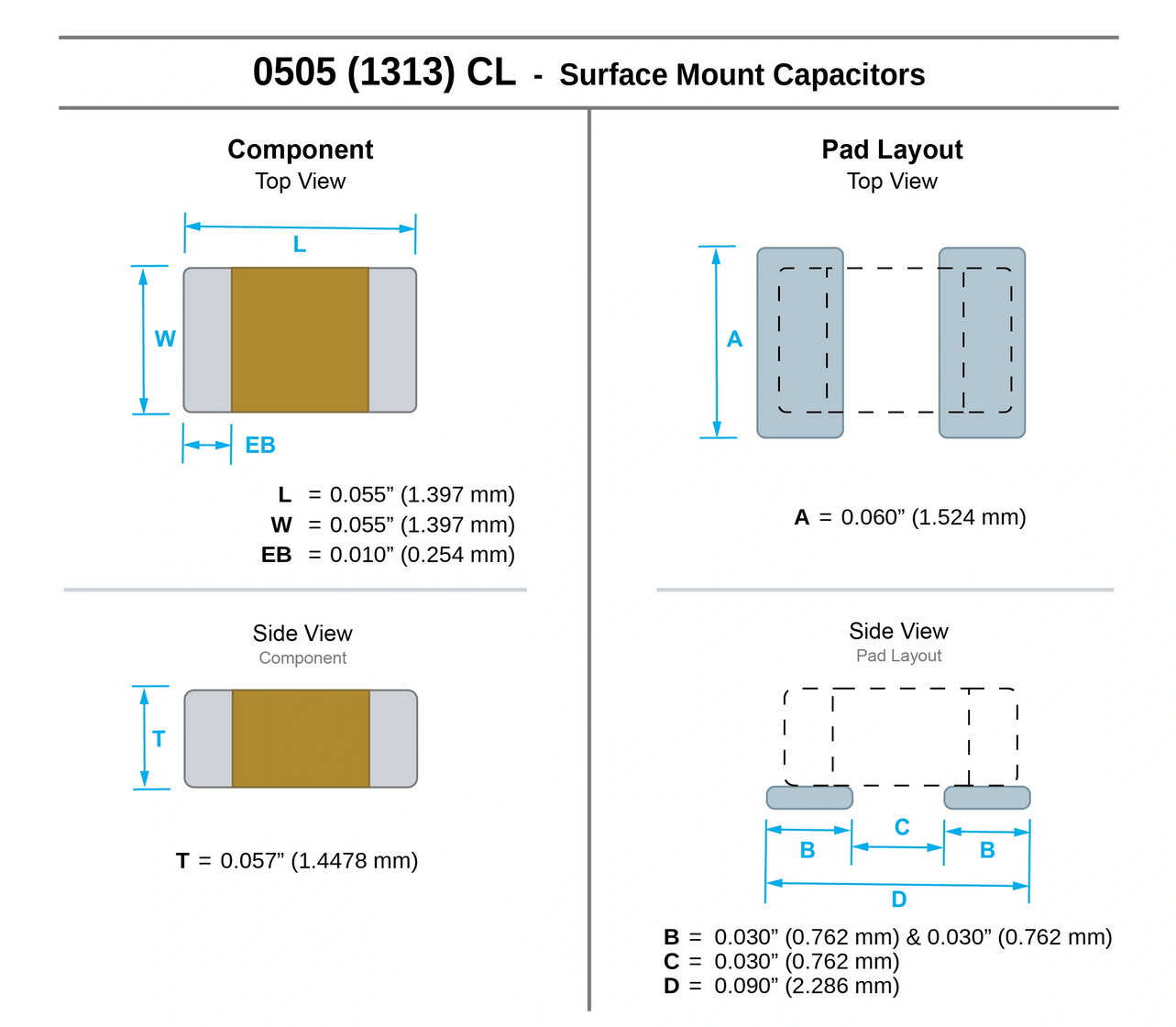
Recommended PCB pad layout for a 0505 (1313) CL surface mount capacitor, showing top and side views with labeled component and pad dimensions in inches and millimeters.
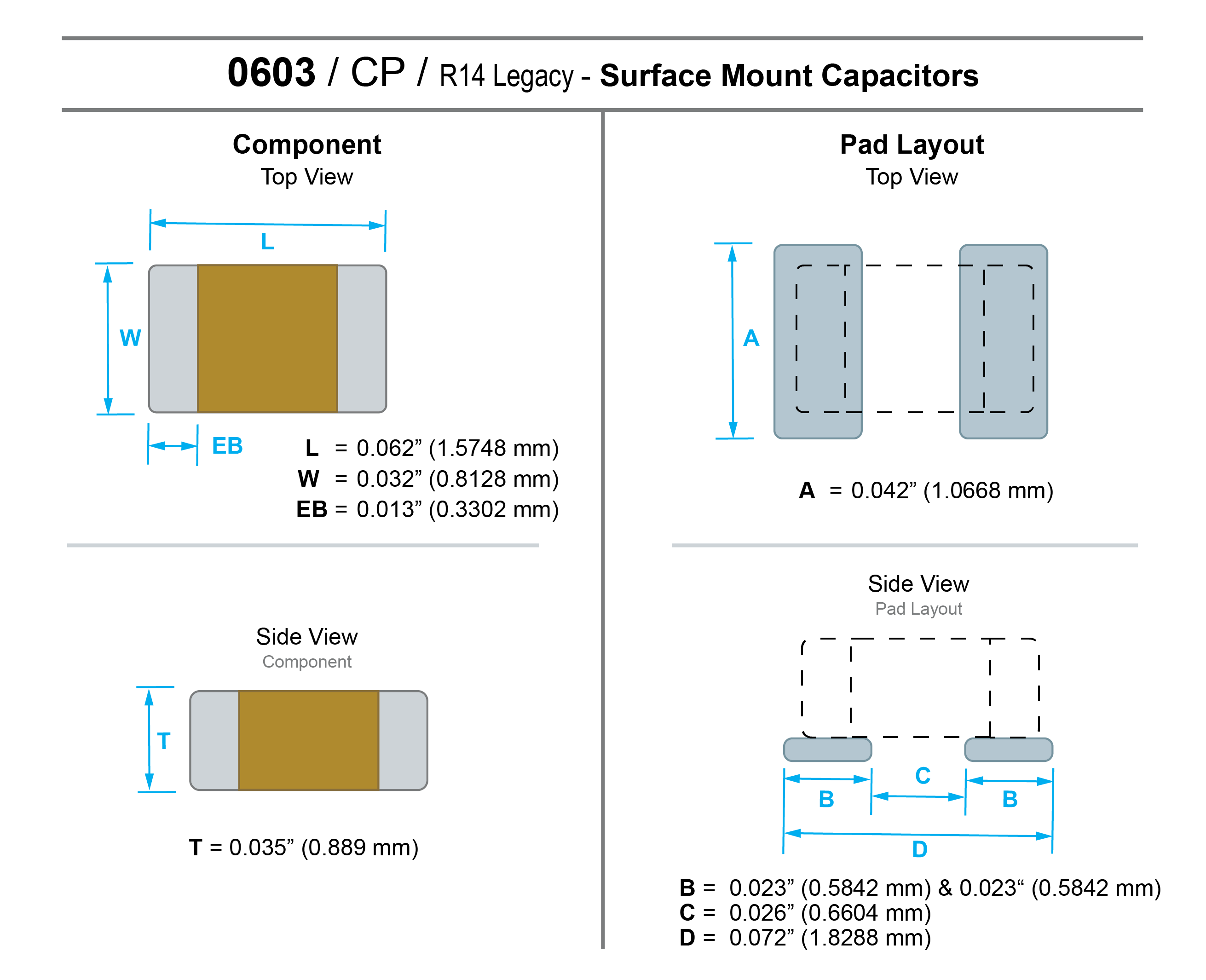
PCB pad layout drawing for a 0603 (CP, R14 legacy) surface mount capacitor showing component and pad dimensions in inches and millimeters
0805 / R15  
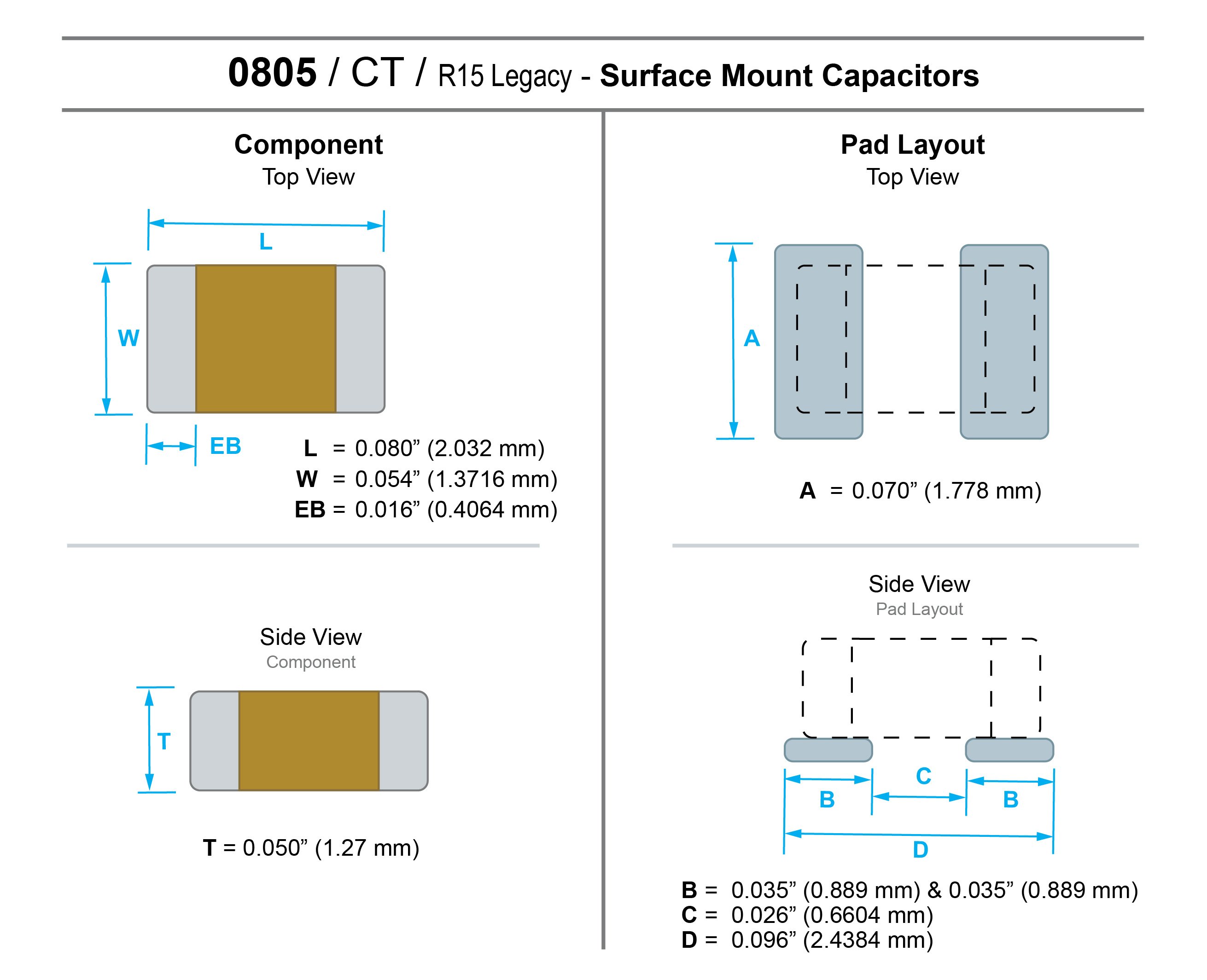
PCB pad layout drawing for a 0805 (CT, R15 legacy) surface mount capacitor showing component and pad dimensions in inches and millimeters
1111 / S42  
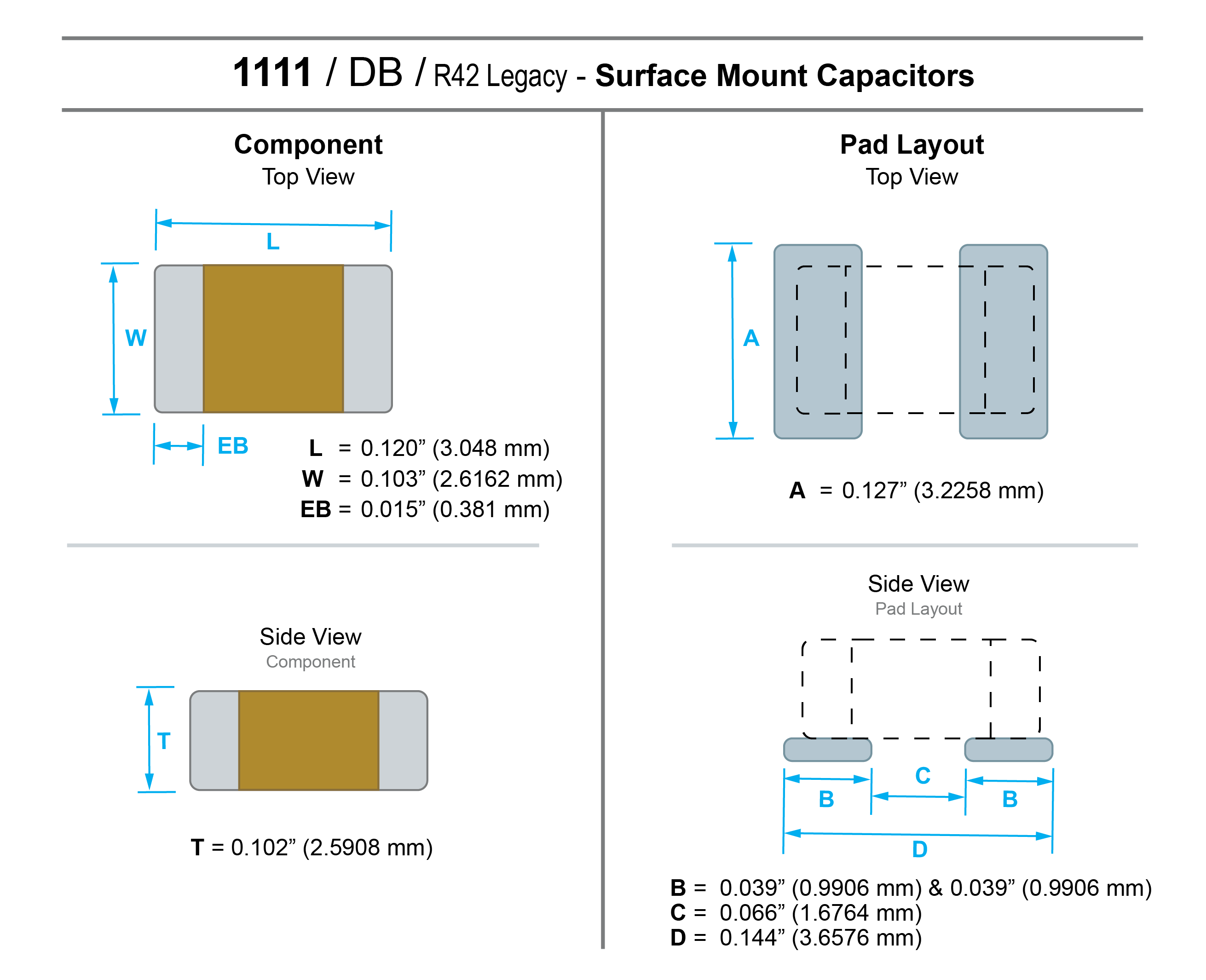
PCB pad layout drawing for a 1111 (DB, R42 legacy) surface mount capacitor showing component and pad dimensions in inches and millimeters
1206 / R18  
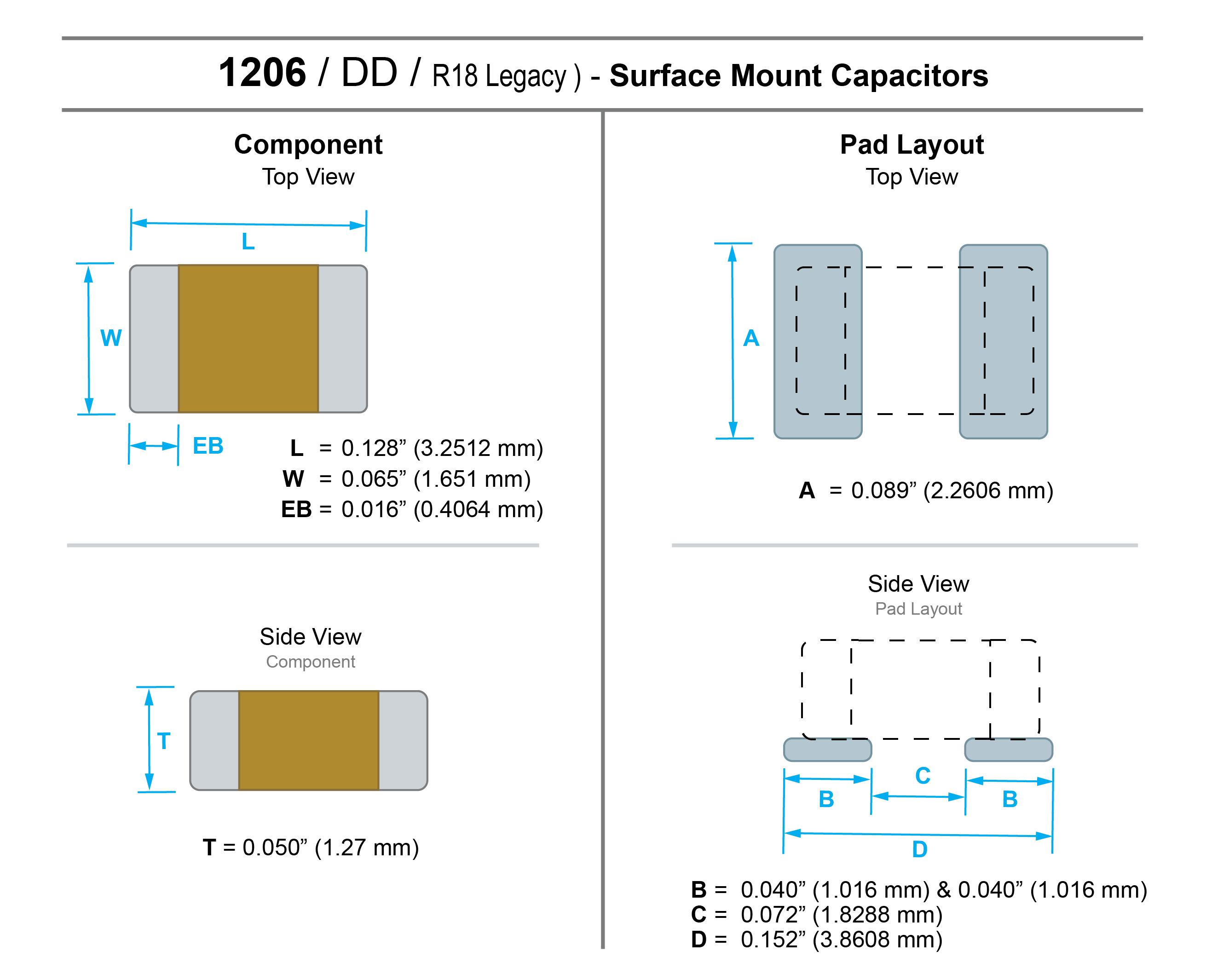
PCB pad layout drawing for a 1206 (DD, R18 legacy) surface mount capacitor showing component and pad dimensions in inches and millimeters
1210 / S41  
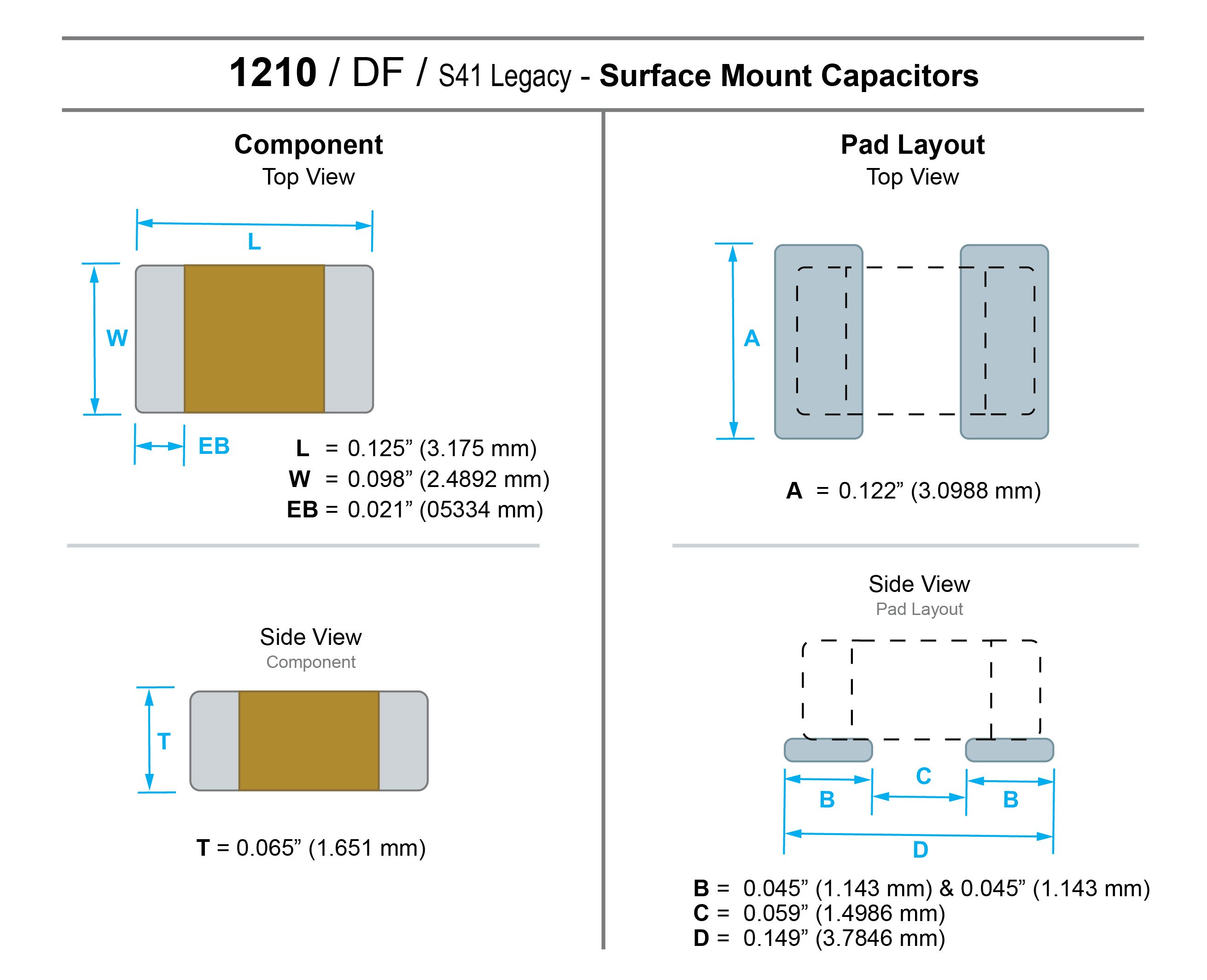
PCB pad layout drawing for a 1210 (DF, S41 legacy) surface mount capacitor showing component and pad dimensions in inches and millimeters
1812 / S43  
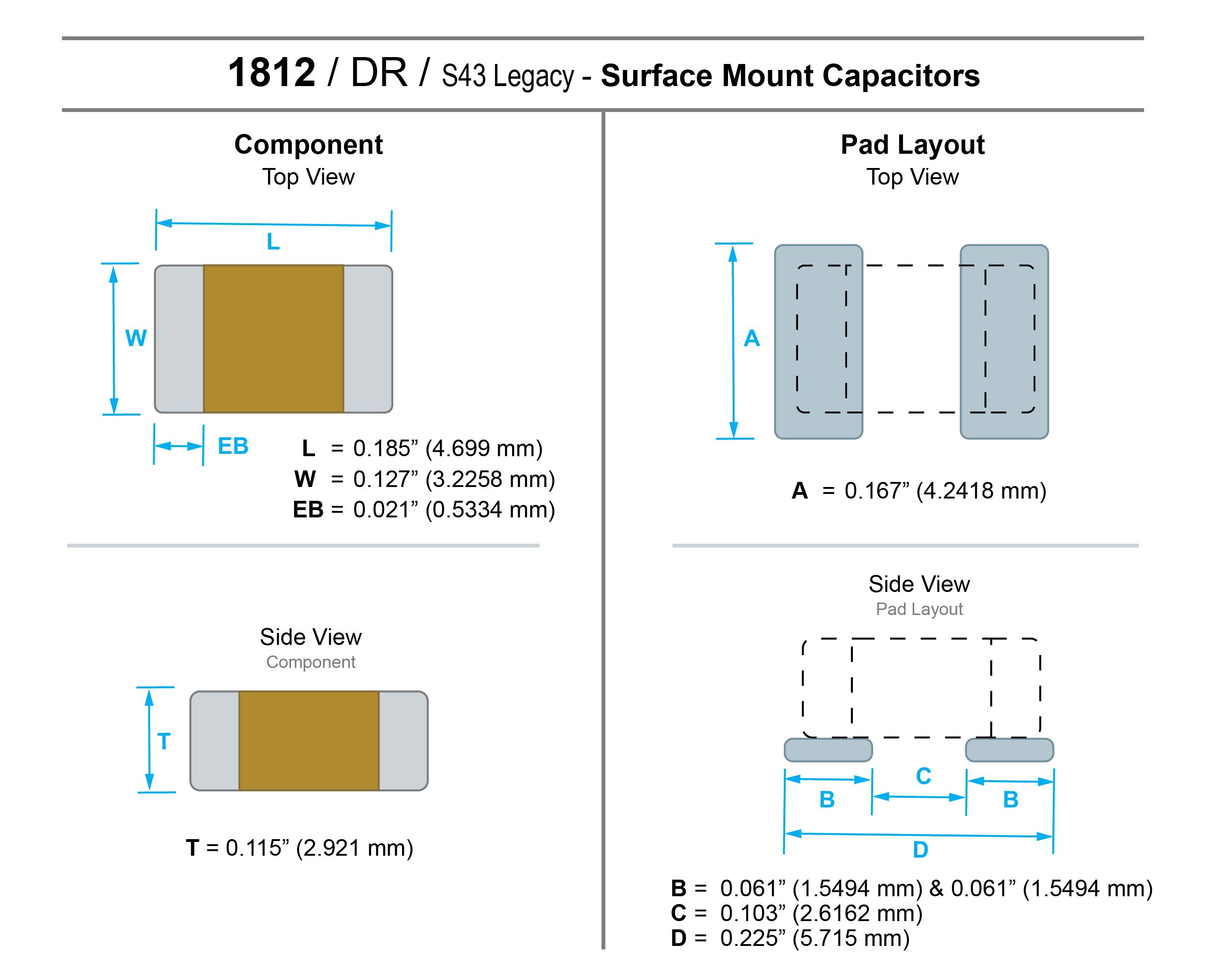
PCB pad layout drawing for a 1812 (DR, S43 legacy) surface mount capacitor showing component and pad dimensions in inches and millimeters
1808 / R29  
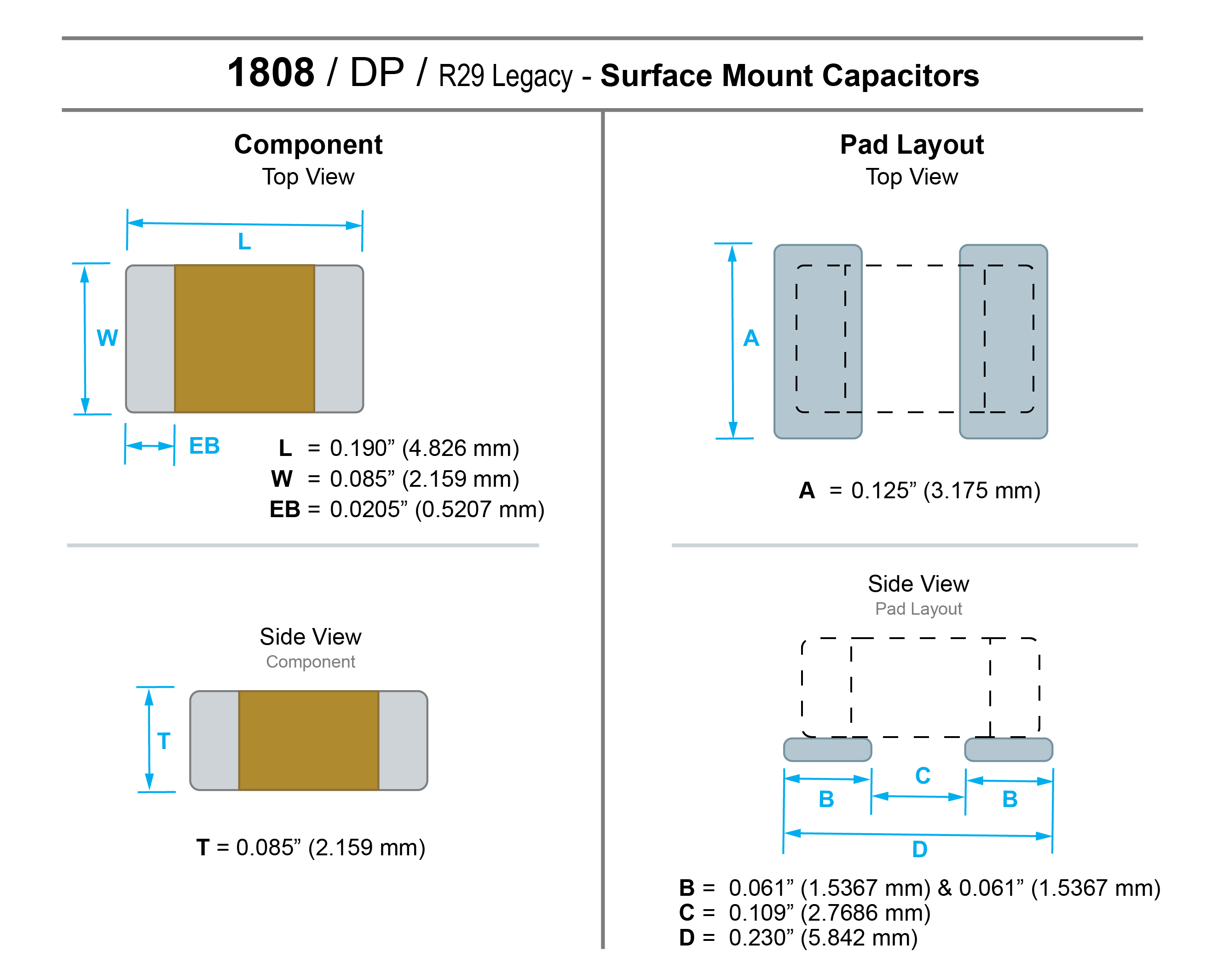
PCB pad layout drawing for a 1808 (DP, R29 legacy) surface mount capacitor showing component and pad dimensions in inches and millimeters
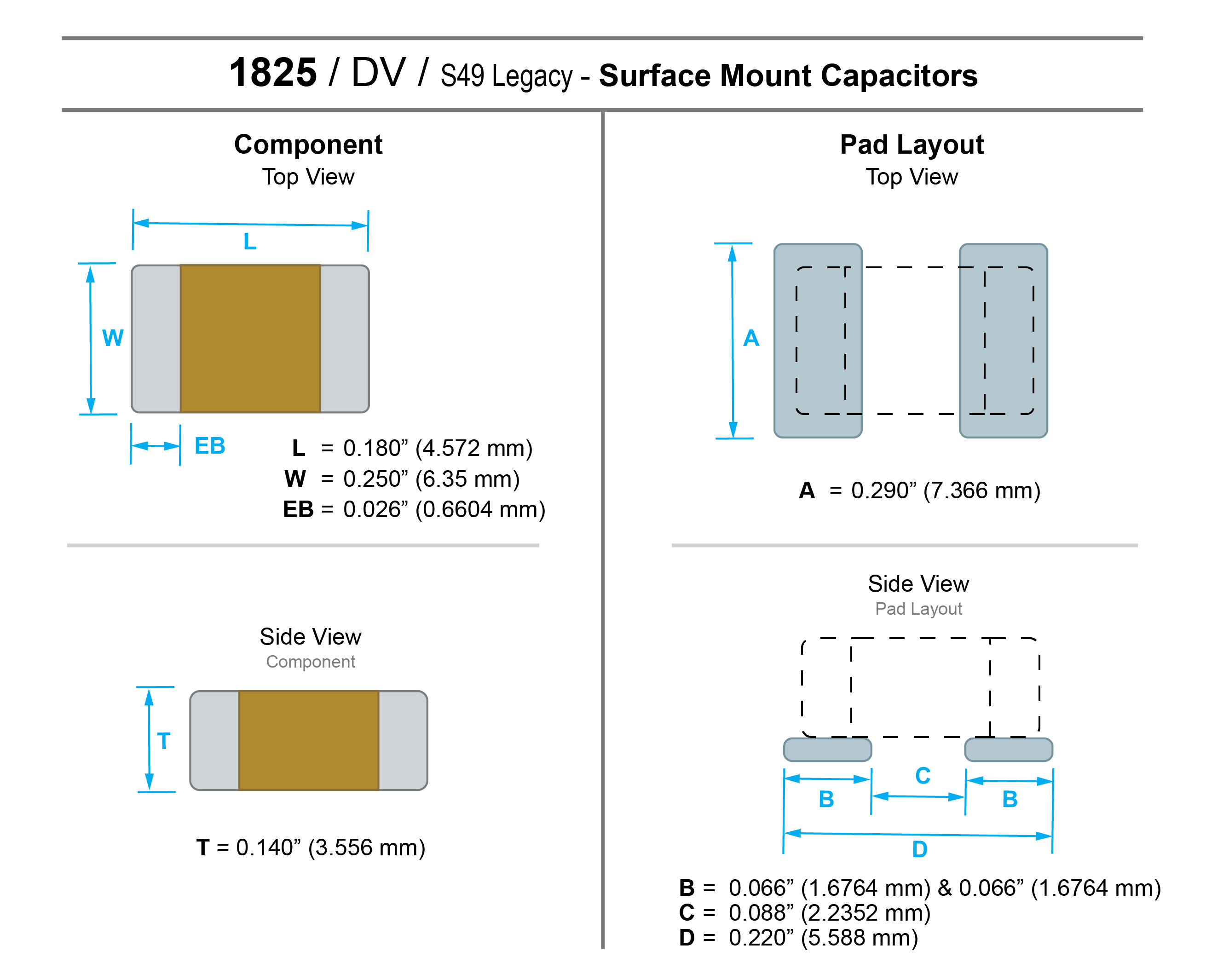
1825 / S49  
PCB pad layout drawing for a 1825 (DV, S49 legacy) surface mount capacitor showing component and pad dimensions in inches and millimeters
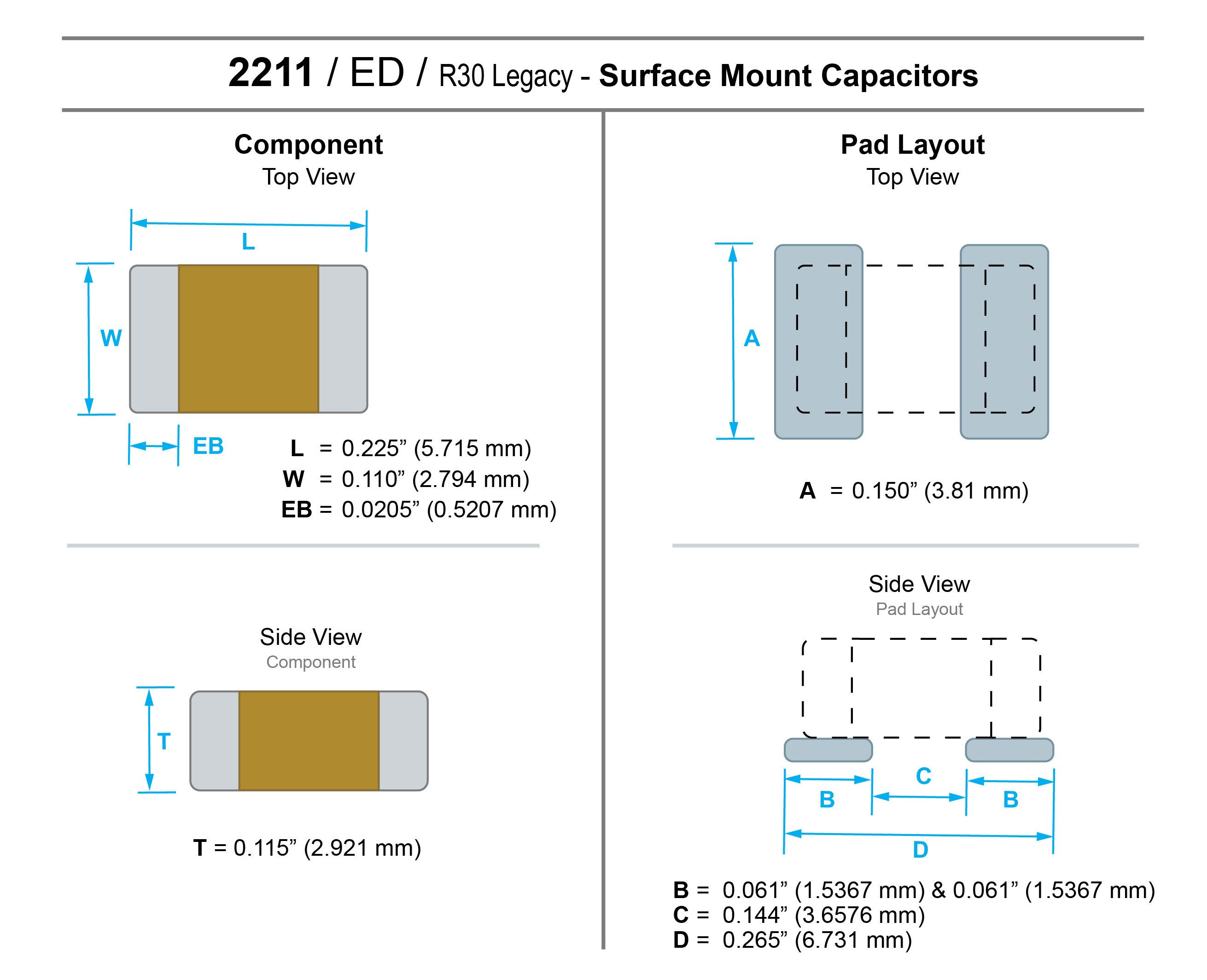
2211 / R30  
PCB pad layout drawing for a 2211 (ED, R30 legacy) surface mount capacitor showing component and pad dimensions in inches and millimeters
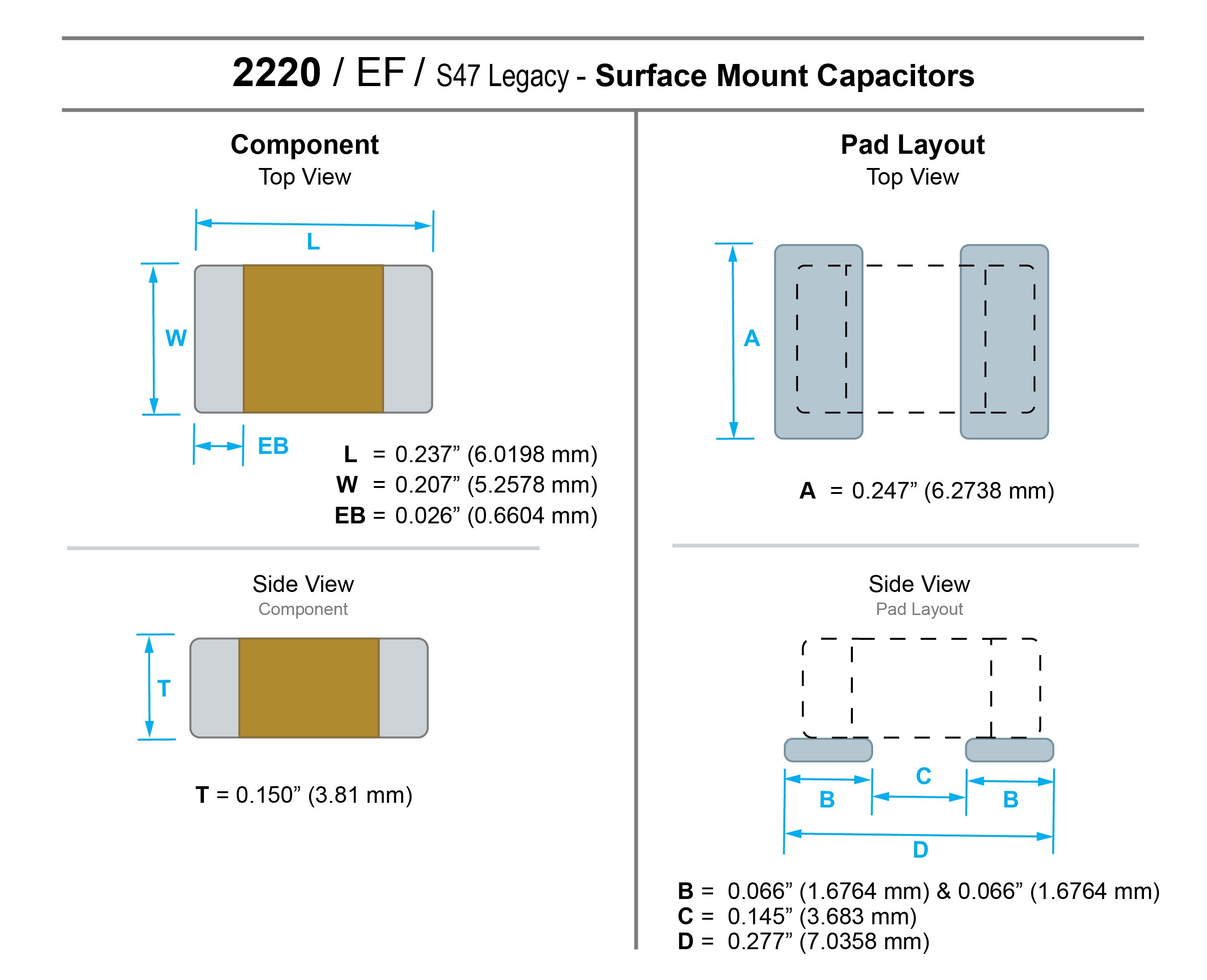
2220 / S47  
PCB pad layout drawing for a 2220 (EF, S47 legacy) surface mount capacitor showing component and pad dimensions in inches and millimeters
2225 / S48  


0.322
(8.1788)

PCB pad layout top view for a 2225 (S48) capacitor showing pad-to-pad dimension A


0.262
(6.6548)
0.230 (5.842)
Component top view for a 2225 (S48) capacitor showing length L, width W and end-band EB dimensions
0.026(0.6604)
 
PCB pad layout side view for a 2225 (S48) capacitor showing individual pad width dimension B
0.086
(2.1844)
0.086
(2.1844)
PCB pad layout side view for a 2225 (S48) capacitor showing the gap dimension C between pads
0.118 (2.9972)
PCB pad layout side view for a 2225 (S48) capacitor showing overall pad span dimension D
0.290 (7.366)

0.160
(4.064)
Component side view for a 2225 (S48) capacitor showing thickness dimension T
2525 / S48E  


2.80
(7.112)

PCB pad layout top view for a 2525 (S48E) capacitor showing pad-to-pad dimension A


0.250
(6.350)
0.230 (5.842)
Component top view for a 2525 (S48E) capacitor showing length L, width W and end-band EB dimensions
0.25(0.635)
 
PCB pad layout side view for a 2525 (S48E) capacitor showing individual pad width dimension B
0.050
(1.270)
0.050
(1.270)
PCB pad layout side view for a 2525 (S48E) capacitor showing the gap dimension C between pads
0.300 (7.620)
PCB pad layout side view for a 2525 (S48E) capacitor showing overall pad span dimension D
0.400 (10.16)

0.150
(0.381)
Component side view for a 2525 (S48E) capacitor showing thickness dimension T
3838 / S58  


0.434
(11.0236)

PCB pad layout top view for a 3838 (S58) capacitor showing pad-to-pad dimension A


0.380
(9.65)
0.380 (9.65)
Component top view for a 3838 (S58) capacitor showing length L, width W and end-band EB dimensions
0.025(0.63)
 
PCB pad layout side view for a 3838 (S58) capacitor showing individual pad width dimension B
0.090
(2.286)
0.090
(2.286)
PCB pad layout side view for a 3838 (S58) capacitor showing the gap dimension C between pads
0.266 (6.7564)
PCB pad layout side view for a 3838 (S58) capacitor showing overall pad span dimension D
0.446 (11.3284)

0.170
(4.32)
Component side view for a 3838 (S58) capacitor showing thickness dimension T

RF Performance
For good RF performance, engineers designing PCBs should consider the following recommendations for Johanson Passives:

  • Pad Size
    • Johanson recommends smaller pad size when compared to the IPC standard. This is done to achieve a compromise between the best RF performance and optimum solderability.
    • Large pad sizes like those recommended by the IPC-SM-782 standard will have RF impedance effects (which can be negative)
  • Pad Symmetry
    • Symmetrical land patterns (pads) are recommended to achieve better RF performance and reduce the likelihood of tombstoning
  • Solder Fillet
    • Solder fillet size can shift impedance at microwave frequencies. Johanson recommends smaller size fillets and consistent size fillets. Large wavelengths tend to be more forgiving with excess solder. Fillets at higher frequencies (very small wavelengths) are much more affected by poor soldering methods. Johanson recommends that the solder fillet be at the lower tolerances in order to minimize RF disruption.
    • Controlling the solder fillet to the low side is an effort to minimize negative impedance effects that occur at higher frequencies.
    • o Smaller solder fillets minimizes thermal and physical stresses

Safety Capacitors


Caution for Safety Caps layouts – Layouts should meet the 3mm (0.1182”) or 4mm (0.1575”) minimum creepage distance between pads as required in the UL or TUV specifications. Here the creepage distance is defined by the “C” dimension in the layout above.