Johanson Announces Compact 2.4 GHz Ceramic Band Pass Filters
2.4 GHz Ceramic Band Pass Filters for Bluetooth®, Wi-Fi, IoT & AEC-Q200 Automotive Applications
Sept. 7, 2026
Overview:
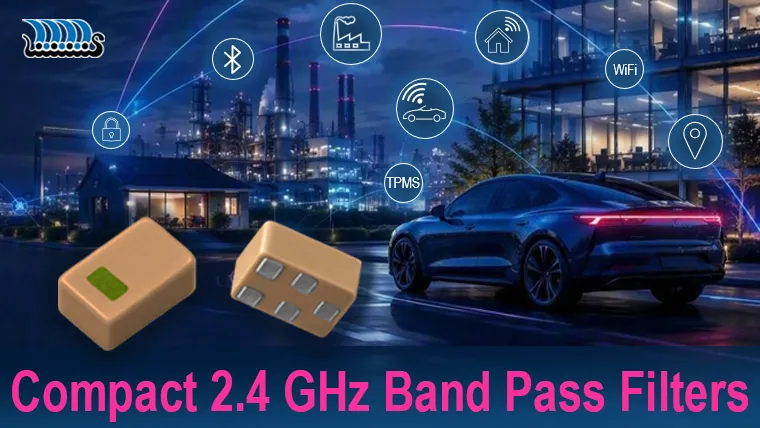
Johanson Technology introduces two new compact ceramic band pass filters for the 2.4 GHz ISM band: Part number 2450BP08D0100001T for commercial, industrial, and IoT wireless applications, and part number 2450BP08D0100002T, an AEC-Q200 qualified version designed for automotive wireless systems.
Both filters provide high-performance RF filtering in a miniature 1.1 × 0.9 mm footprint, helping designers improve signal integrity, reduce interference, and conserve valuable PCB space.
2450BP08D0100001T — 2.4 GHz Band Pass Filter for Bluetooth®, Zigbee®, Thread & IoT
2450BP08D0100001T is optimized for wireless designs using technologies such as Bluetooth® LE, Zigbee®, Thread, and ANT+. Typical applications include smart home devices, building automation systems, industrial sensor networks, asset tracking, secure access systems, and location-based services.
Its combination of low insertion loss and strong out-of-band rejection helps improve receiver sensitivity and RF coexistence in crowded wireless environments.
2450BP08D0100002T — AEC-Q200 2.4 GHz Band Pass Filter for Automotive Applications:
2450BP08D0100002T provides compact 2.4 GHz RF filtering with AEC-Q200 qualification for automotive electronics.
Applications include Bluetooth® connectivity, digital keys, tire pressure monitoring systems (TPMS), in-cabin sensing, in-vehicle Wi-Fi hotspots, connected-car access points, and Bluetooth Channel Sounding systems.
Datasheets and Specifications:
Start evaluating:
Review product specifications and get datasheets:
Get Technical Support, Samples, Quotes:
RF Technical Support & Product Inquiries
How do these filters help accelerate product development?
By providing a compact, pre-engineered RF filtering solution, engineers can reduce design risk, simplify RF front-end development, and improve the likelihood of achieving desired wireless performance during testing and validation.
How do I know if a 2.4 GHz band pass filter is needed in my design?
If your design experiences interference issues, limited wireless range, receiver sensitivity concerns, failed RF performance testing, or coexistence challenges with multiple radios, a dedicated 2.4 GHz band pass filter may help improve overall system performance.
Why do I need a band pass filter in a 2.4 GHz wireless design?
The 2.4 GHz ISM band is increasingly crowded with Bluetooth®, Wi-Fi®, Matter, Zigbee®, Thread, and other wireless technologies. A band pass filter helps suppress unwanted signals outside the desired frequency range, improving receiver sensitivity, wireless reliability, and overall RF performance.
How can a band pass filter improve receiver sensitivity?
Unwanted RF energy reaching the receiver can reduce sensitivity and make it more difficult to detect weak signals. By rejecting out-of-band interference, a band pass filter helps the receiver focus on the desired 2.4 GHz signal, improving communication range and link reliability.
Can these filters help solve RF coexistence issues?
Yes. RF coexistence is a common challenge in devices that support multiple wireless technologies. The filters are designed to provide strong out-of-band rejection, helping reduce interference between wireless systems and improving overall coexistence performance
Which wireless technologies are these filters designed to support?
The filters are optimized for 2.4 GHz wireless applications including Bluetooth® LE, Zigbee®, Thread, ANT+, Matter-enabled devices, and other ISM-band wireless systems.
What challenges do these filters help engineers solve?
Common design challenges include:
Poor wireless range
Reduced receiver sensitivity
RF interference from nearby devices
Coexistence issues between multiple radios
Limited PCB space
Automotive reliability requirements
These filters are designed to address these challenges while maintaining a compact footprint.
How much PCB space do these filters require?
Both filters feature a miniature 1.1 x 0.9 mm footprint, helping engineers add RF filtering without consuming valuable board space. This is particularly beneficial for compact IoT, wearable, sensor, and automotive designs.
Are these filters suitable for Matter devices?
Yes. Since Matter commonly utilizes Thread operating within the 2.4 GHz band, these filters can help improve signal integrity and wireless performance in Matter-enabled smart home products.
Which filter should I choose for automotive applications?
The 2450BP08D0100002T is the automotive version and is AEC-Q200 qualified. It is intended for applications requiring the enhanced reliability standards commonly demanded by automotive manufacturers and Tier 1 supplier.
What automotive systems can benefit from these filters?
Typical automotive applications include:
Bluetooth® connectivity
Digital key systems
Tire Pressure Monitoring Systems (TPMS)
In-cabin sensing
In-vehicle Wi-Fi hotspots
Connected car access points
Bluetooth® Channel Sounding systems
What is AEC-Q200 qualification, and why does it matter?
AEC-Q200 qualification indicates that a passive component has been tested to automotive industry reliability standards. This helps engineers select components suitable for harsh automotive operating environments and long-term reliability requirements